


The Fight Against MCPS Efforts to Censor Student Journalism
(8/1/2026) | Tula Dasgupta
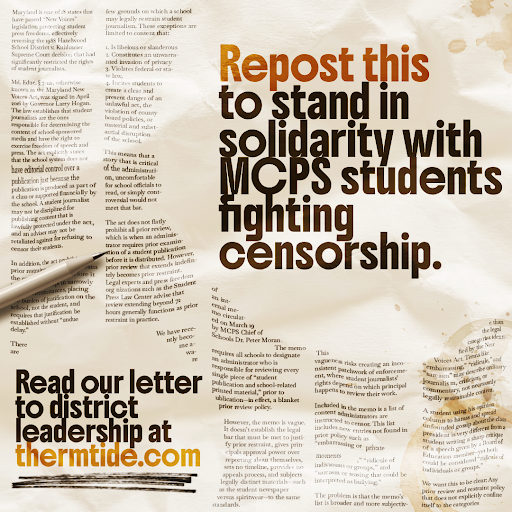
The open letter cover, first published by Ian Chen with the RM Tide. Graphic courtesy Wendi Ling with the RM Tide.
On March 19, Montgomery County Public Schools (MCPS) released a memo written by Dr. Peter Moran, Chief of Division of School Leadership and Improvement, introducing requirements that MCPS student publications should be reviewed prior to being circulated. It included basic standards to follow, such as prohibiting the use of “profanity or vulgar language” , promotion of bullying or harassment, and other rules. More specifically, the memo advised against the “invasion of privacy (embarrassing or private moments),” inappropriate photos, and, most controversially, it prohibited “language that implies wrongdoing without verification.”
As the memo was shared, students quickly realized that the vagueness of each rule allowed for wide restrictions that could be placed at the school administrator’s discretion. The memo was targeted at “student publications,” but in reality, this could apply to anything from Senior class t-shirts to student-made and fact-checked opinion pieces.
Nearly entirely student-led, the MCPS journalism program is a multi-level elective class where students learn the basics of journalism and publish articles in a print newspaper and/or online, learning researching, writing, fact-checking skills, and more. For many young writers, journalism in MCPS is a rare place in which students can express their own opinions, conduct investigative projects, and represent other students. Many young journalists worried that such blanket restrictions could be used as prior restraint against articles that voiced student opinion and discussed more controversial topics.
Ian Chen, a rising junior at Richard Montgomery HS and Features Editor for the RM Tide, spent months putting together a team of journalism leaders from across the county and working to bring regional and national attention to this.
Chen created a network of hundreds of students and petition signers who signed off on an open letter to MCPS. The letter explains why the memo must be disassembled and how it infringed on student journalism rights, citing Maryland’s New Voices Act. The New Voices legislation, adopted by at least 18 states including Maryland, is designed to counteract the Supreme Court decision Hazelwood School District v. Kuhlmeier. This case changed the environment for school-sponsored student journalists by allowing parent school/organizations to censor student work; the New Voices Act aimed to reinstate student journalism rights and push back against censorship.
“We want this to be clear,” the open letter says, which was written with advice from the Student Press Law Center, Journalism Education Association, and other organizations with the interest of protecting journalist rights. “Any prior review and restraint policy that does not explicitly confine itself to the categories the New Voices Act identifies as legally restrainable is inconsistent with the law and undermines student journalism.”
Chen later appeared as a guest on local news podcast I Hate Politics. . In the episode, he explained that “the most obvious way the memo is inconsistent with the [Maryland New Voices Act] is that the list of content that administrators are instructed to censor outright…falls far beyond the purview of the New Voices Act.”
Three other student journalists interviewed for the same episode–Zoe Gorbachev, Seva Gandhi, and Annabel Taylor–all agreed that the memo threatened student journalism, but for different reasons:
While Ian Chen and Zoe Gorbachev—editor-in-chief of Blair’s print newspaper, Silver Chips—emphasized the ideological aspect and its clear violation of New Voices Legislation, Seva Gandhi and Annabel Taylor, co editors-in-chief of Walt Whitman’s newspaper, The Black and White, discussed significant instances where the school newspaper uncovered scandals and published exposés.
All three journalists worried that the memo would prevent journalists from being able to expose scandals that may otherwise go unnoticed while also keeping confidential witnesses protected, citing one of The Black and White’s most famous stories that covered harassment that occurred at an annual event at Whitman HS.
“Under this new memo, this could technically be considered… “implying wrongdoing without verification,” and the principal would have to vet this anonymous student who needs to remain anonymous for fear of retaliation [and] that compromises our role as journalists,” Ms. Gandhi noted.
In a statement, Moran argued that the memo was not intended to restrain young journalists, but rather to prevent more “instances at schools where inappropriate content was printed, but not reviewed first, in school yearbooks and other publications.”
Since the initial pushback, MCPS has neither withdrawn the memo nor released any updated drafts. While the story seems to be stagnant for now, it is likely that the dust will be kicked back up after the school year starts, provided that school administrators choose to enforce the new policies.
Sources:
Comments